Ray and path tracing
Exact shadows, reflections, ambient occlusion, global illumination and whole paths of light, each a single call. Hardware on Vulkan GPUs with ray queries, shader code everywhere else, a Mac included.
Java · Skia · Metal, OpenGL & Vulkan
RenGL is a Java toolkit with its own widgets, a 2D game framework and an optional 3D layer. No CSS, no native widgets, no boring defaults. Everything is styled from plain Java.
Everything on this screen is drawn by RenGL.
Now public
The engine is on GitHub and on Maven Central. A lot has been added since the first demos.
Exact shadows, reflections, ambient occlusion, global illumination and whole paths of light, each a single call. Hardware on Vulkan GPUs with ray queries, shader code everywhere else, a Mac included.
Draw a fraction of the pixels and enlarge them. A built-in temporal upscaler works on every GPU. AMD FSR 3, NVIDIA DLSS and Apple MetalFX, plus DLSS and FSR frame generation, come from the optional rengl-upscale module.
About 2000 lights through a clustered grid, surfaces that glow onto their surroundings, occlusion culling, and generated levels of detail with a picture card for the far distance.
Step the same PhysicsWorld with NVIDIA PhysX 5 from rengl-physx in one line, or stay on the built-in pure-Java solver. Bodies, joints and characters stay as they are.
Every control has a role, a name and a Tab stop. Add rengl-accessibility and the window speaks, and on Windows NVDA, JAWS and Narrator can read it through UI Automation.
Web views, gamepads, knobs, gauges, joysticks, minimaps and a radial menu, list boxes, toasts and tool bars, scatter and bubble charts, isometric and hex tile maps, text in any script and files dragged in and out of the window.
Accessibility, levels of detail and a few other additions are on main and arrive in the next release; Maven Central has 0.1.1.
See it move
A custom SkSL shader as the background, translucent panels with gradient borders, gradient text and the stock widgets. All of it is RenGL.
Thousands of pooled, batched particles, a shader-drawn sky and a scrolling city, in a plain window with no game engine on top.
Physically based materials, image-based sky lighting, shadows, fog and about 2000 dynamic lights, some of them blinking, plus bloom, ambient occlusion and a colour grade, on Vulkan or OpenGL, shown inside the same UI. It can trace shadows, reflections and whole paths of light, upscaled with DLSS, FSR or MetalFX. Programs that don't use it never pay for it.
RenGL Editor
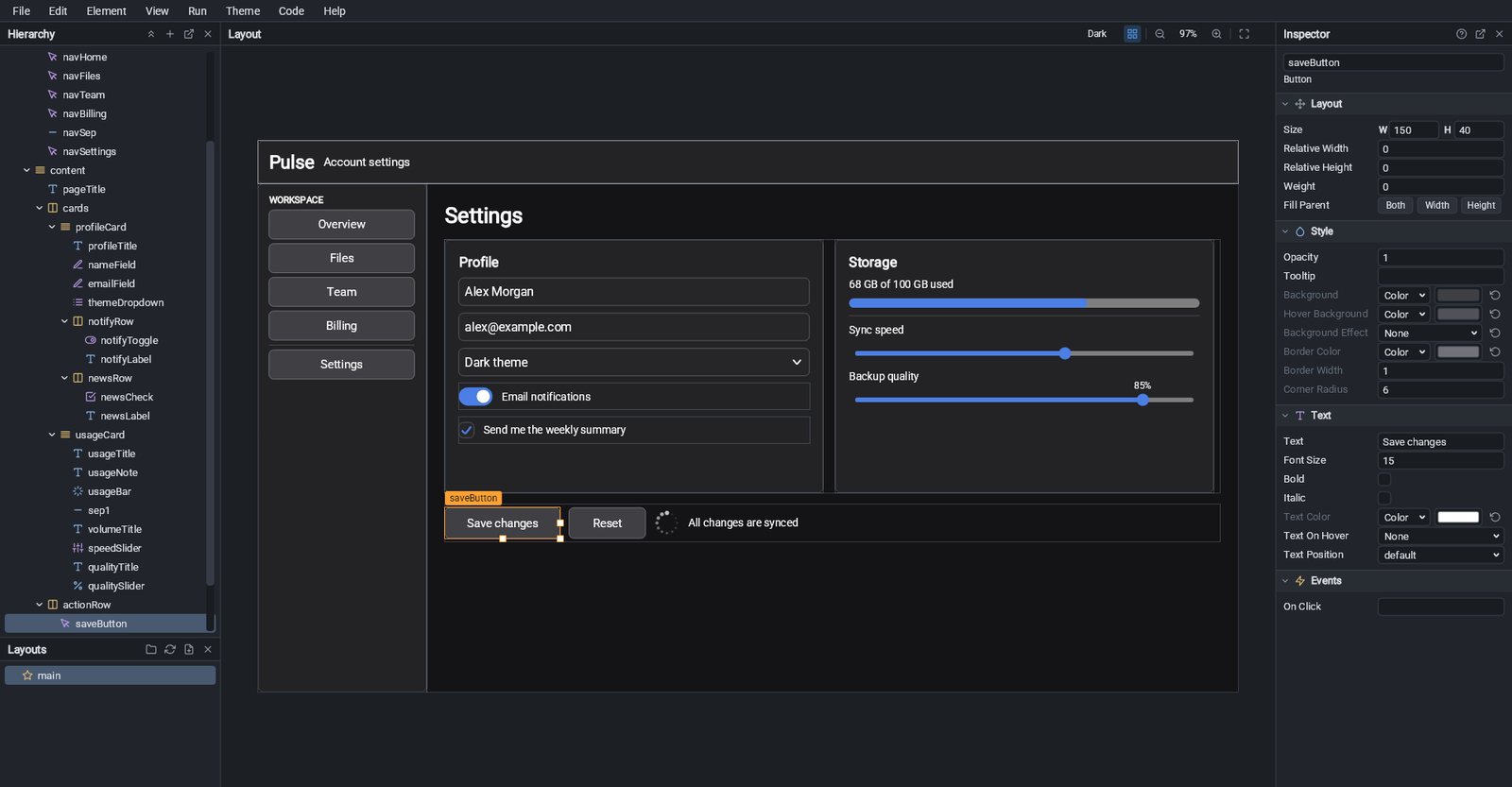
The RenGL Editor is a visual editor for apps, 2D games and 3D games, built with RenGL itself. Drag and style a screen, run it in its own window, and write the Java behind it without leaving the tool.
Look around
Dig into what RenGL can do, how the code reads, and what has been built with it.
Features
A UI toolkit with charts, layouts, styling, animation, a 2D game framework, audio and video, optional 3D and the plumbing around them.
Browse the featuresCode
Detailed, copy-ready Java for every feature: forms, docking layouts, particles, shaders, 3D lighting, physics and more.
Read the examplesProducts
RenGL is used for real apps, not just demos. See what has been made with it so far.
See the productsModules
RenGL is split into Maven modules, so a program never carries libraries it doesn't use. One dependency, RenGL, still pulls in nearly all of them. Everything is published to Maven Central as io.github.piitex.
rengl-core is the window, the UI toolkit, input and the 2D game framework.rengl-upscale (FSR, DLSS, MetalFX) and rengl-physx (PhysX 5) are left out of RenGL on purpose.setup.exe, .deb or .rpm, for all three platforms from one computer.<dependencyManagement>
<dependencies>
<dependency>
<groupId>io.github.piitex</groupId>
<artifactId>rengl-bom</artifactId>
<version>0.1.1</version>
<type>pom</type>
<scope>import</scope>
</dependency>
</dependencies>
</dependencyManagement>
<dependencies>
<dependency>
<groupId>io.github.piitex</groupId>
<artifactId>rengl-core</artifactId>
</dependency>
<dependency>
<groupId>io.github.piitex</groupId>
<artifactId>rengl-audio</artifactId>
</dependency>
</dependencies>Get started
JDK 25 and a GPU with Metal (macOS) or OpenGL 3.3 (Windows, Linux). Vulkan 1.1 is optional. Any Maven 3 works, and the repository includes a wrapper.
RenGL is on Maven Central. Depend on the engine, and on the natives for the platform you run on (windows, linux or macos, each also with an -arm64 variant). The guide has a pom.xml that picks them for you.
<dependency>
    <groupId>io.github.piitex</groupId>
    <artifactId>RenGL</artifactId>
    <version>0.1.1</version>
</dependency>
<dependency>
    <groupId>io.github.piitex</groupId>
    <artifactId>rengl-natives-windows</artifactId>
    <version>0.1.1</version>
</dependency>Clone the repository and build the rengl-examples module, then run Demo, FireworksDemo or Studio3DDemo from your IDE with the repository folder as the working directory. On macOS add the JVM flags below.
git clone https://github.com/piitex/RenGL.git
cd RenGL
./mvnw -pl rengl-examples -am package -DskipTests

# macOS only, as JVM options:
-XstartOnFirstThread --enable-native-access=ALL-UNNAMEDmain and later releases are Apache-2.0.
Read the license ↗